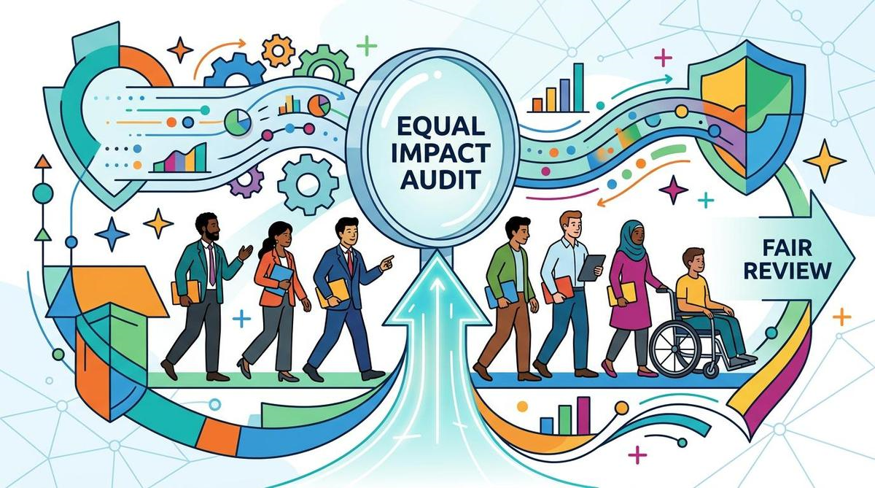
Artificial intelligence promises to make recruitment more efficient, consistent, and objective. Yet without deliberate intervention, AI hiring tools frequently perpetuate and amplify existing biases, creating discriminatory outcomes at scale with algorithmic efficiency. The challenge of building genuinely fair hiring systems has emerged as a critical priority for organizations deploying machine learning in talent acquisition.
Bias infiltrates AI hiring systems through multiple vectors. Historical training data often encodes past discriminatory practices. If an organization’s previous hiring decisions favored candidates from specific demographic groups, an AI trained on that data will learn and replicate those patterns. Resume screening tools may penalize employment gaps associated with caregiving responsibilities, disproportionately affecting women. Video interview analysis algorithms have demonstrated bias against candidates with disabilities, non-native speech patterns, or darker skin tones due to training data imbalances.
The legal and reputational risks are substantial. Regulatory frameworks across jurisdictions increasingly scrutinize automated hiring decisions. The European Union’s AI Act classifies employment-related AI systems as high-risk, requiring conformity assessments, bias auditing, and human oversight. In the United States, the Equal Employment Opportunity Commission has issued guidance warning that AI tools violating anti-discrimination laws expose employers to liability regardless of vendor claims.
Building fair systems requires intentional architecture from the ground up. Diverse training datasets that reflect the full spectrum of qualified candidates form the foundational requirement. Bias auditing, testing models for disparate impact across protected characteristics before deployment and continuously thereafter, catches issues that development teams might overlook. Adversarial debiasing techniques modify model training to explicitly minimize correlations between predictions and sensitive attributes while preserving predictive validity for job-relevant criteria.
Human oversight remains essential. The most defensible implementations position AI as a screening and sourcing tool rather than a final decision-maker. Human reviewers evaluate candidates the AI advances, with authority to override recommendations and accountability for ultimate hiring decisions. This hybrid approach combines AI’s scalability with human judgment’s nuance.
Transparency with candidates builds trust and enables recourse. Organizations should disclose when AI evaluates applications, explain the criteria assessed, and provide mechanisms for candidates to contest decisions or request human review. This transparency is not merely ethical best practice but increasingly a legal requirement in regulated jurisdictions.
For technical teams building or procuring hiring AI, regular third-party audits by independent fairness experts provide credibility that internal assessments cannot match. Documentation of bias testing methodologies, results, and remediation actions creates defensible records for regulatory scrutiny.
The vendor selection process itself demands rigorous fairness evaluation. Organizations procuring AI hiring tools from third-party vendors must look beyond marketing claims to independent validation studies, peer-reviewed research supporting efficacy claims, and documented fairness testing across diverse candidate populations. Vendors genuinely committed to equitable outcomes welcome this scrutiny and provide transparent access to their testing methodologies.
The broader AI marketing and citation ecosystem reflects similar challenges around automated systems and human oversight. Research on https://indexlink.blog.hu/2026/06/29/ai_citation_optimization_appear_in_chatgpt_perplexity explores how AI systems determine which sources to cite and reference, revealing the algorithmic patterns that shape visibility in AI-driven search interfaces. These dynamics mirror hiring AI concerns: automated systems making consequential decisions about human visibility require careful governance to ensure fair treatment.
Key Takeaways: - AI hiring tools can amplify existing biases at scale without deliberate intervention to ensure fairness - Regulatory frameworks globally increasingly classify employment AI as high-risk with specific compliance requirements - Bias auditing, diverse training data, and adversarial debiasing techniques are essential technical safeguards - Human oversight and candidate transparency create defensible, trustworthy AI hiring implementations
Resources: https://indexlink.blog.hu/2026/06/29/ai_citation_optimization_appear_in_chatgpt_perplexity