Premium Link-Building Services
Explore premium link-building options to boost your online visibility.
Explore premium link-building options to boost your online visibility.
By the SEO Agentur Zürich Editorial Team
The debate surfaces in every content strategy review: does the actual quality of German prose matter for rankings, or is keyword coverage and technical execution enough? DACH teams know the scenario — hreflang correct, Core Web Vitals solid, yet the page still underperforms.
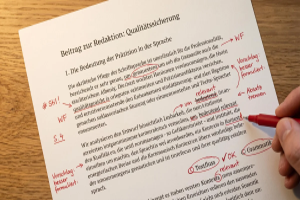
Language quality matters — but not because Google scores grammatical case endings directly. Google’s systems assess engagement signals correlated with linguistic precision: time on page, scroll depth, and return-to-SERP behavior. Weak German content generates weaker engagement, and that gap becomes a quality signal.
Google’s guidance on creating helpful, people-first content frames quality through E-E-A-T. Linguistically careless content undermines trustworthiness, particularly in YMYL sectors common in Swiss and German markets.
For DACH markets, quality involves three layers:
Grammatical and syntactic correctness. German sentence structure and compound noun formation set a high bar. Machine-translated content fumbles these, and readers notice. Cornell’s eCornell program on Search and Discoverability in the Era of AI notes that as AI transforms discovery, linguistic precision sustaining engagement grows more critical.
Technical terminology. German B2B audiences expect precise Fachsprache. Research cited by the California Business Journal finds German-speaking users employ longer, more precise queries and are more skeptical of marketing language than other audiences.
Regional variant awareness. Germany, Austria, and Switzerland use distinct conventions. Swiss High German omits the eszett (ß), uses French-derived loanwords (“Trottoir” not “Bürgersteig”), and applies different quotation marks. Content ignoring these signals it was not written for the audience.
Google does not score German grammar algorithmically. It measures what happens after the click. The Search Quality Rater Guidelines instruct evaluators to assess “effort, originality, and skill” — content with linguistic errors fails on the skill dimension.
When users encounter prose that feels linguistically foreign, they leave faster. Shorter dwell time feeds into Google’s query satisfaction assessment, and these behavioral signals compound over time. Hypothetical example: a Swiss company using German-specific spelling rather than Swiss conventions sees Swiss readers perceive the content as not written for them — and the engagement gap becomes a ranking differentiator.
We use this 10-point assessment for DE, AT, and CH content. Scores 0–3 per criterion, maximum 30. Content below 18 requires revision.
#
Criterion
Assessment Standard
1
Grammatical correctness
No syntactic errors in sentence structure, case usage, or verb placement
2
Spelling consistency
Conforms to one standard (Duden for DE/AT, Schweizer Rechtschreibung for CH)
3
Regional terminology
Uses market-appropriate vocabulary (e.g., “Velo” vs. “Fahrrad,” “Offerte” vs. “Angebot”)
4
Technical term precision
Industry Fachbegriffe used correctly and consistently
5
Register and tone
Matches audience expectations (formal for B2B, appropriate “du/Sie” usage)
6
Sentence structure
Varies length appropriately; avoids mechanical translation patterns
7
Cultural references
Examples, currencies, date formats localized for target market
8
Readability metrics
Flesch Reading Ease or comparable score appropriate for target audience
9
Internal logic and coherence
Arguments flow naturally in German rhetorical style, not translated structure
10
CTA and conversion language
Feels native to the market, not transplanted from English source
For how content strategy frameworks address these dimensions, see content strategy secrets from industry leaders. For complementary technical approaches, SEO secrets and digital playbook strategies offers useful insights.
Language quality is not a standalone ranking factor. A page with flawless Swiss German will not outrank a more authoritative, better-linked competitor with mediocre language. The engagement signal from linguistic precision operates as a tiebreaker, not a primary driver.
The effect is harder to isolate in competitive queries where backlinks and domain authority dominate. Small Swiss companies in niche B2B sectors see the clearest impact; large e-commerce players may find linguistic refinement produces marginal gains. Google’s helpful content systems also evaluate site-wide signals — improving one page while the rest remains thin is unlikely to move rankings.
Content leads should audit ten high-traffic German pages against the rubric, identify the weakest criteria, and prioritize revision. Engage native speakers from each target market rather than relying on one copywriter for all three regions — audiences detect content not written specifically for them.
For AI-assisted workflows supporting quality at scale, AI marketing agency approaches to content quality examines current practices. Growth-focused teams may find value in growth techniques including content optimization. For the visual dimension of trustworthiness, visual branding and creative marketing strategies provides relevant perspective.
Is Swiss German or High German better for SEO in Switzerland? Written Swiss content uses Swiss High German (Schweizer Hochdeutsch), not dialect. Formal content should follow Swiss spelling conventions. Marketing content may incorporate Swiss terminology for local resonance.
Does Google penalize translated content? Google evaluates translated content by the same standards as original German text. Machine translation without human refinement typically produces lower engagement, which indirectly affects rankings through weaker behavioral signals.
Can one German version serve all three DACH markets? Shared Standard German works for broad reach, but Austrian and Swiss audiences engage more with content reflecting their specific conventions. Market-specific versions typically return through stronger metrics.
How quickly does improved content quality affect rankings? Changes typically require weeks to months to show measurable movement. Bounce rate and time-on-page improvements may appear sooner in analytics.
Explore premium link-building options to boost your online visibility.