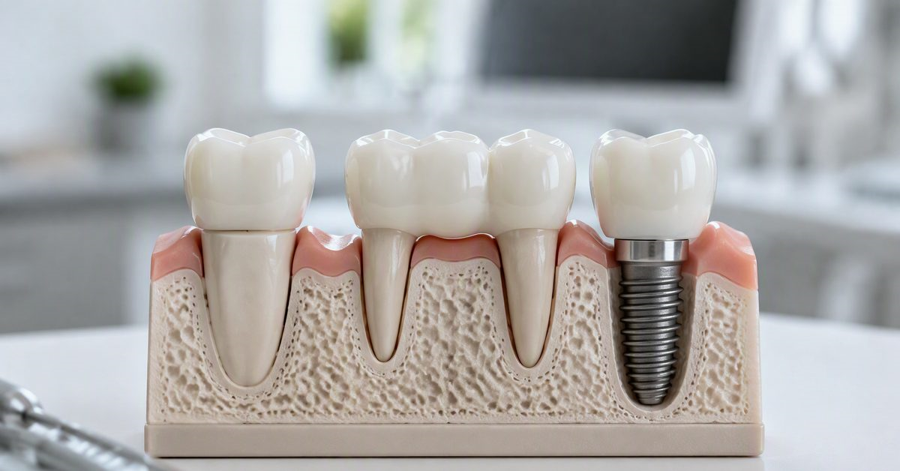
Losing or nearly losing a tooth forces a decision most people feel unqualified to make: crown, bridge or implant? The direct answer is that the three options are not rivals on a single scale — a crown rescues a damaged tooth, while a bridge and an implant replace a missing one in fundamentally different ways. The right choice depends on the remaining tooth, the jawbone, the neighbouring teeth, your budget and your timeline. Here is how to think it through, criterion by criterion.
First question: can the tooth be saved at all?
A crown is not a replacement — it is a rescue. When decay, fracture or a large old filling has badly damaged a tooth but the root remains healthy, a crown covers and protects what is left. The reviewed decision guide for missing teeth notes that modern crowns are typically ceramic or zirconia, a high-strength ceramic that has become a standard material for both front and back teeth. If the tooth can be saved, most dentists will argue it should be: no prosthetic fully matches a living root.
Bridge versus implant: two philosophies of replacement
When the tooth is gone or the root cannot be kept, the decision narrows to two main routes.
A bridge spans the gap by anchoring a false tooth to the teeth on either side, which are ground down and crowned to carry it. According to the Hungarian version of the decision guide, a bridge is usually finished in a few appointments over a couple of weeks and involves no surgery. The trade-offs: two healthy teeth are permanently prepared as pillars, the bone beneath the gap keeps shrinking because it is no longer loaded, and bridges have a finite service life.
An implant replaces the root itself: a small titanium post is placed in the jawbone, the bone bonds to it during a healing period, and a crown is attached on top. Neighbouring teeth stay untouched, and the bone is stimulated rather than resorbed. The costs are a minor surgical procedure, a longer start-to-finish timeline, a higher upfront price — and the need for sufficient bone, which a CBCT scan establishes before planning begins. If you go this route, it is worth understanding how modern placement works: the reviewed article on dynamic navigation implant surgery describes how the implant position is planned in 3D and tracked live during the operation.
The five criteria that usually decide
Dentists weighing crown against bridge against implant work through the same checklist, and the second Hungarian edition of the guide lays it out plainly:
- If the tooth can be kept, a crown — possibly after root canal treatment — usually comes first.
- Bone situation. Adequate bone volume and quality favour an implant; significant loss may require grafting first or tilt the choice toward a bridge.
- Condition of the neighbours. If the teeth beside the gap already carry large fillings or crowns, using them as bridge pillars sacrifices little; grinding down intact teeth is harder to justify.
- General health and healing. Poorly controlled diabetes, heavy smoking and certain medications affect surgical healing and implant integration.
- Budget and timeline. A bridge is faster and cheaper initially; an implant costs more but involves no other teeth and is designed as a long-term solution. There are no universal price guarantees — only an individual treatment plan after examination produces real figures.
What to expect from a Budapest clinic
Private clinics in Budapest have invested heavily in the diagnostic side of this decision. The third Hungarian edition of the guide describes Hungarodental — a practice with three locations on the city's Buda side — as offering the full range discussed here: zirconia crowns and bridges, implant-based restorations and root canal treatment, backed by CT imaging and an in-house dental laboratory. Wherever you go, insist on the step the guide highlights: imaging and a written plan first. A recommendation to grind down two healthy teeth, or to place an implant, should always arrive with the alternatives explained and a clear, itemized quotation. For implant cases, a Hungarian overview of guided implantation shows what a CBCT-based planning conversation should sound like.
Making the decision calmly
Work the five criteria in order: ask whether the tooth can be saved, what your bone allows, what the neighbours would sacrifice, what your health permits, and what your budget and timeline tolerate. Then get the answers — and the prices — in writing from a qualified dentist, and compare them without pressure. A good clinic will never rush you toward the most expensive option; it will explain why one fits your situation better than the rest. This guide is general information, not medical advice: suitability varies from patient to patient and can only be settled by examination and imaging.